Grants
Landscape Regeneration
Big Devon Meadows Count
£10,800 awarded
Project Dates: 15.04.24 to 15.12.25
Moor Meadows has created a successful volunteer-led model on Dartmoor to inspire landowners to create or restore meadows, and share expertise to encourage more people to get involved.
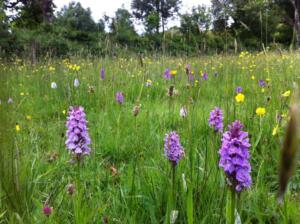
The Big Devon Meadows Count is a two year project with a pilot in the first year. It will audit, survey, evaluate, and protect as many species-rich grassland sites as possible across Devon – increasing knowledge of this under-represented habitat to better understand the extent and quality of fragmented sites.
There is currently a lack of consistent data on meadows outside of SSSIs and County Wildlife Sites; a lack of support for small meadow owners; and a lack of data on new species-rich meadows created through green hay or seeding. This means a whole set of new meadow sites in Devon are under-recorded and unrecognised.
The Big Devon Meadows Count will empower landowners by giving them the tools, knowledge, and survey skills to better protect grassland sites.
It will provide training and a common format for recording information about site boundaries, species lists, and habitat management.
In year 1, a pilot project will collect data for a minimum of 59 sites that will be digitised and analysed by Devon Biodiversity Records Centre. By the end of the second year, another 230 sites will be added. At the end of the project there will be a celebration of sites, a review of progress, and a discussion within the network about how privately-owned grassland habitats can be best protected for the future.
Key project deliverables:
- A clearer picture of the extent and quality of species-rich grasslands in Devon owned and managed by Moor Meadows members (currently 575 sites)
- Better site protection through inclusion of data in DBRC database, local authority, planning, and other searches, and for use in agri-environmental schemes
- An empowered group of landowners who have the skills and information necessary to protect and manage grasslands into the future.
Image credits: Moor Meadows
IMPACT SUMMARY JANUARY 2026:
Project Activities
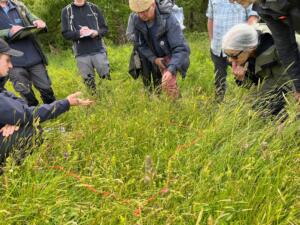
- 14 botanical survey training sessions over 9 days, successfully training 142 people, including a special “train the trainer” day for experienced volunteers.
- The project successfully generated valuable ecological data, identifying 363 different plant species across more than 12,000 individual records.
- The project provided clear guidance and developed new species identification films for meadow plants with the assistance of an independent ecologist.
- Volunteer surveyors and landowners actively collected and submitted ecological data, ultimately covering 209 meadows.
- To streamline this process, a new HabMapper app was developed in 2025 in collaboration with the Devon Biodiversity Records Centre (DBRC) and the Devon Wildlife Trust.
- Project organisers engaged directly with hundreds of farmers, landowners, and volunteers through face-to-face meetings, online webinars, and printed brochures.
Project Impact
-
As a direct result of the detailed surveys, four meadows were officially designated as County Wildlife Sites (CWS) in 2025, significantly exceeding the project’s targets. Another 15 sites are expected to go to the CWS panel for designation in 2026, and a further 44 sites were identified as good quality grassland that may eventually meet CWS criteria.
-
The initiative significantly enhanced the botanical skills of those involved. From the 365 landowners who initially registered, 137 individuals successfully submitted data covering 209 meadows. An evaluation survey in autumn 2025 showed that 33% of participating landowners felt the project increased knowledge of their specific meadow, 31% felt it improved their general botanical knowledge, and 10% gained better insight into managing their sites for biodiversity.